
Data Center Policy Notes For Activists
May 2026, Vol 2. Issue 34

The Core Argument
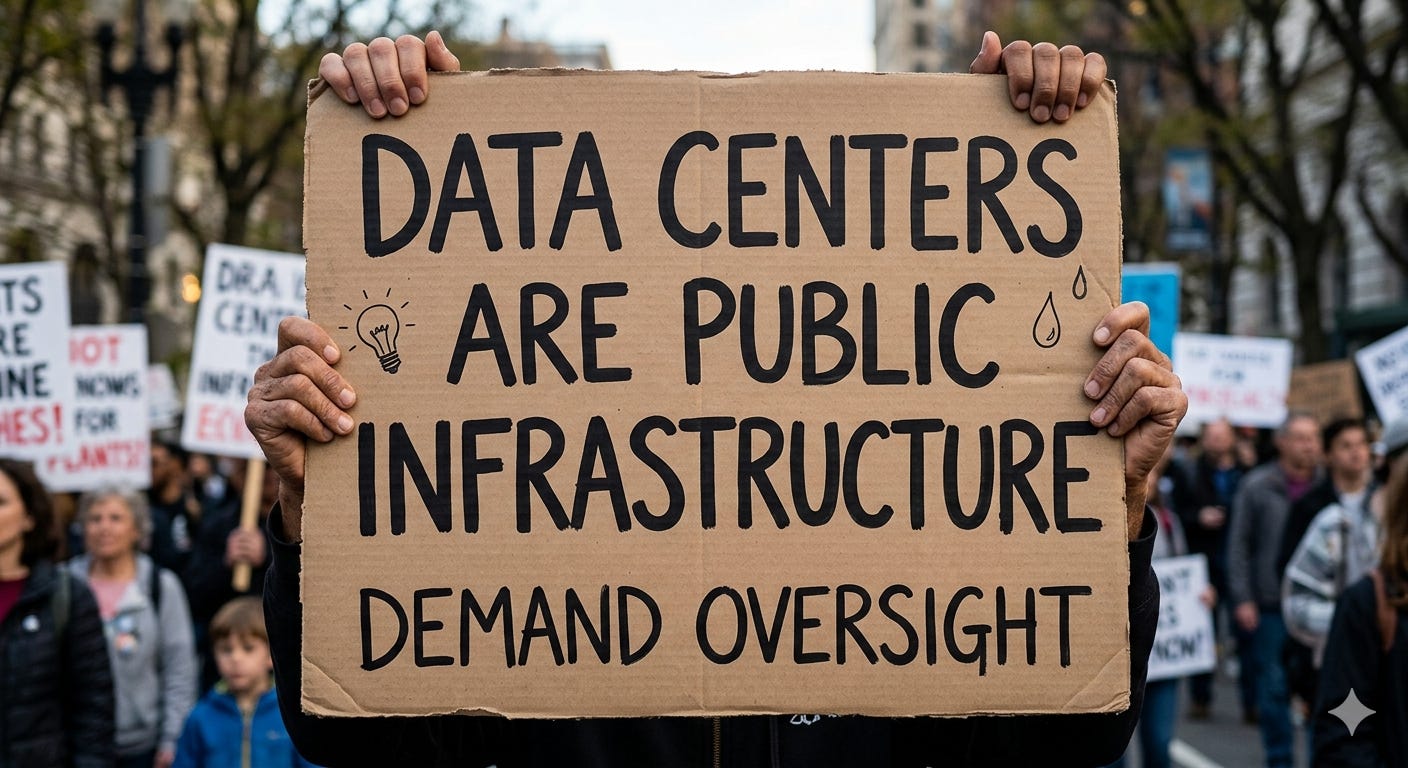
Data centers should be regulated as critical infrastructure, not treated as private corporate warehouses.
The rapid expansion of hyperscale computing facilities is concentrating enormous demands for water, electricity, land, and public infrastructure while increasing corporate control over essential digital systems.
Current policy frameworks are inadequate because they still treat data centers primarily as engineering projects or economic development deals rather than critical infrastructure.
A serious regulatory framework should include:
mandatory water and energy disclosure,
restrictions in water-stressed regions,
grid impact assessments,
industrial electricity rate structures,
bans on secrecy agreements involving public utilities,
resilience and redundancy standards,
proportional infrastructure financing,
and public oversight comparable to other critical infrastructure sectors.
Voluntary corporate sustainability pledges are not governance.
Why This Matters
The current AI boom accelerated a problem that already existed.
The issue is not simply ChatGPT or AI. Nearly all digital activity now depends on massive centralized computing infrastructure: cloud storage, logistics, finance, streaming media, surveillance systems, retail platforms, government services, communications networks, and AI itself.
Hyperscale computing generates enormous heat, making cooling an industrial-scale water and electricity problem.
But this concentration is not simply a technical necessity. It is an economic and political choice driven by profitability, platform dependency, and market control.
The Scale of the Resource Problem
Google consumed more than 6 billion gallons of water for cooling in 2023. Amazon Web Services still does not publicly disclose total water consumption figures. Meanwhile, major firms continue expanding infrastructure as AI demand accelerates.
Taken together, North American data centers consumed an estimated 264 billion gallons of water in 2025, while electricity demand continues rising sharply.
Utilities across the United States are already warning that data center growth is driving demand for new substations, transmission lines, reserve generating capacity, and power plants.
The political question increasingly facing regulators is straightforward:
Who pays for this expansion?
Increasingly, the answer may be ordinary ratepayers.
Multiple states are already debating whether residential customers will indirectly subsidize hyperscale infrastructure through higher utility bills.
Centralization Creates Infrastructure Risks
The early internet emphasized distributed computing resilience. Today’s cloud economy remains technically networked, but operational control and resource dependency have become increasingly centralized.
The same concentration that creates efficiencies also creates systemic vulnerabilities.
Finance, healthcare, logistics, education, communications, retail platforms, and government systems increasingly depend on centralized cloud infrastructure. Outages at major providers already create cascading disruptions across multiple sectors simultaneously.
These facilities now function as critical infrastructure regardless of whether governments formally regulate them as such.
We already regulate dams, airports, power plants, and telecommunications systems with public risk in mind. Hyperscale computing infrastructure deserves similar scrutiny.
The Transparency Problem
Despite consuming vast quantities of public water and electricity, operators frequently invoke trade secrecy protections to limit disclosure.
Utilities and municipalities sometimes sign nondisclosure agreements preventing communities from learning how much water or electricity industrial users consume.
In The Dalles, Oregon, legal pressure forced disclosure showing Google facilities consuming more than a quarter of the city’s municipal water supply.
This is not simply an environmental issue. It is a democratic accountability issue involving public resources.
What Activists Should Focus On
Data center expansion is often approved quietly through zoning boards, utility commissions, and regional permitting processes long before public attention arrives.
Key pressure points include:
utility transparency,
industrial water disclosure laws,
electricity rate structures,
zoning and permitting hearings,
environmental impact reviews,
infrastructure subsidy agreements,
resilience standards for concentrated cloud infrastructure,
and secrecy agreements involving public utilities.
Most people still do not understand how rapidly this infrastructure is expanding or how heavily it depends on public resources.
Political Accountability Matters
Elected officials who approve large-scale infrastructure deals involving public water, electricity, tax subsidies, or secrecy agreements should be on the public record and held politically accountable for those decisions.
These are not private business arrangements. They are public infrastructure decisions with long-term consequences for utility costs, resource allocation, environmental stability, and regional development.
Communities should know:
who approved these agreements,
what subsidies were granted,
what disclosures were waived,
who absorbs infrastructure costs,
and what public oversight exists once projects are operational.
Political accountability and public pressure remain among the few effective counterweights to corporate secrecy and infrastructure concentration.
What good govt and citizen action groups need to get this post??